You finish a book, or close the app, and something lingers. Not fear, exactly. More like recognition. Dystopian stories work because they’re rarely pure inventions. They borrow pieces of the world you already live in, then take those ideas in a more extreme direction. That’s the whole trick, really.
Dystopian stories feel real because they are often built from familiar fears, social problems, and human behavior. They explore ideas such as surveillance, inequality, government control, technology, and loss of freedom.
The Psychology Behind the Genre
Here’s the thing nobody really tells you upfront. This kind of fiction isn’t about predicting doom. It can give readers a fictional space to explore fears, uncertainty, and difficult questions.
Watching social collapse play out on a screen lets you sit with the big questions: Who would you trust? What would you protect? How would you respond if everything around you suddenly changed? That’s part of why people enjoy dystopian stories even when the content itself is bleak.
A few reasons this hits so hard:
- Human behavior under pressure feels familiar, even in an unfamiliar setting
- Fear of technology shows up constantly; most of us already feel a little uneasy about how much control we’ve handed over
- Loss of freedom in fiction mirrors small losses you’ve probably felt yourself, even minor ones
- Social collapse as a theme taps into something primal, needing to know you’d survive it
None of this is random. It’s part of what makes dystopian stories so engaging.
Realistic Examples You Already Know
You don’t have to look far for realistic dystopian fiction examples. Many borrow ideas from real-world concerns. Surveillance states echo debates around mass surveillance and privacy. Authoritarian governments in fiction can also reflect concerns about political oppression and concentrated power.
Government control as a theme rarely comes from nowhere either. Writers observe real institutions and social systems, then imagine what might happen when limits on power become weaker.
Quick breakdown of how fictional elements map onto real anxieties:
| Fictional Element | Real-World Root |
| Surveillance networks | Ongoing debates about mass surveillance |
| Rationed resources | Actual social inequality and scarcity |
| Silenced dissent | Political oppression in various regimes |
| AI-run systems | Genuine fear of technology outpacing regulation |
| Collapsed institutions | Historical examples of social collapse |
That overlap is exactly why dystopian stories reflect society so closely. It just gives the anxiety a shape you can actually look at, finally.
Why People Keep Coming Back, Even to Bleak Stories
That overlap helps explain why dystopian stories can reflect society so closely. Fiction gives these concerns a shape that readers can actually see and explore.
Modern dystopian fiction themes almost always carry some thread of hope. A character who resists. A small act of rebellion. A community surviving against odds it shouldn’t. Without that thread, honestly, most of these narratives wouldn’t hold anyone’s attention past chapter two.
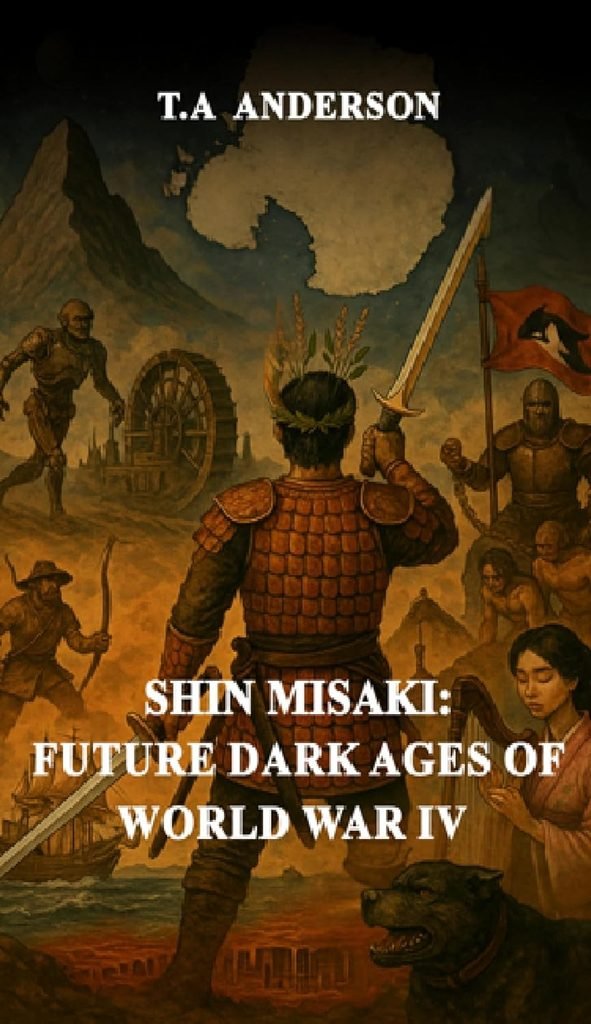
Theodore A. Anderson explores similar ideas through stories of survival, conflict, discipline, and resistance. His work leans into that tension between collapse and the will to keep going. His book, Shin Misaki and the Future Dark Ages of World War IV , explores a future society under strain without losing sight of what people fight to hold onto.
Real World Themes Behind the Fiction
Real-world dystopian themes rarely announce themselves loudly. They show up gradually. A policy here. A surveillance tool there. By the time anyone notices the pattern, it’s already normalized, quietly.
This is where dystopian fiction earns its reputation as more than just entertainment. It’s a warning system wearing a story’s costume, and readers pick up on that instinctively even if they couldn’t explain exactly why a scene felt uncomfortably close to home.
Fiction and Reality Keep Blurring
Dystopian stories and reality have always had a strange, tangled relationship. Fiction predicts. Reality catches up. Then fiction pushes further again. A loop that’s been running for decades now, and it’s not exactly slowing down.
Found this angle interesting? You might want to read how dystopian fiction explores power, control, and freedom too, since it digs deeper into the mechanics behind these same fears.
What These Narratives Teach You About Human Behavior
Strip away the collapsed cities and rationed resources, and most dystopian stories about society are really studying human behavior under pressure: how people react when comfort disappears. Who cooperates, who hoards, who quietly resists.
That’s honestly the more interesting layer, if you ask people who read the genre closely. Future society scenarios aren’t really the point. They’re just the setup. The real question every story keeps circling back to is simpler than it looks: what would you actually do if the rules you rely on just stopped applying one day.
Final Thoughts
This kind of fiction feels real because it’s not really about the future at all. It’s about right now, just stretched a little. Social inequality, government control, technological fears- none of it’s invented from nothing. Borrowed, stretched, handed back to you as a story.
Theodore A. Anderson explores similar ideas through stories of survival, conflict, resilience, and life after global destruction. As long as the real world keeps handing fiction material to work with, this genre isn’t going anywhere.
FAQs
ecause they’re not really made up from scratch. Writers borrow real stuff- government control, surveillance, inequality- and just push it further than it’s actually gone. That’s the whole reason it feels plausible instead of far-fetched.
Honestly, it’s not the bleakness people like. Most of these stories have someone who resists anyway, some thread of hope buried in there. That’s usually what keeps readers hooked, not the collapse itself.
Somewhat, yeah. Older stories leaned on nuclear fear and rigid authoritarian control. Modern dystopian fiction themes lean harder into technological fears, data, and algorithms, reflecting anxieties specific to the world we’re actually living in now.